
High Intensity Interval Training (HIIT) or functional fitness training, such as challenging boot camps and quick workouts of the day (WODs), have become the latest trend in fitness. This form of exercise promises to rapidly enhance cardiovascular health, reduce fat and build muscle by combining compound lifts, plyometrics and relentless pacing.
However, beyond the surface appeal, there is a strong functional truth. If the muscles develop faster than the connective tissues—specifically, without increasing tendon stiffness sufficiently—high-intensity workouts can actually harm, not help, the body.
Why WODs Can Lead to Injury: A Functional Glitch
Movements performed at high speed, including box jumps, Olympic lifts done against the clock and short bursts of sprints, heavily rely on the functional unit consisting of muscle and tendon (MTU). Tendons are not just cords; they are live, elastic structures that collect and then release mechanical energy.
The fundamental issue in high-intensity functional training is that there can be a mechanical incompatibility in the muscle-tendon unit (Mersmann et al., 2017). Muscles adapt quickly to the stress of intense exercise, gaining more strength within weeks. Tendons, conversely, have a limited blood supply (hypovascular) and heal much more slowly.
When a person with less tendon stiffness—tendons that are compliant or ‘stretchy’—attempts explosive, numerous-repetition WODs, it can trigger several negative situations.
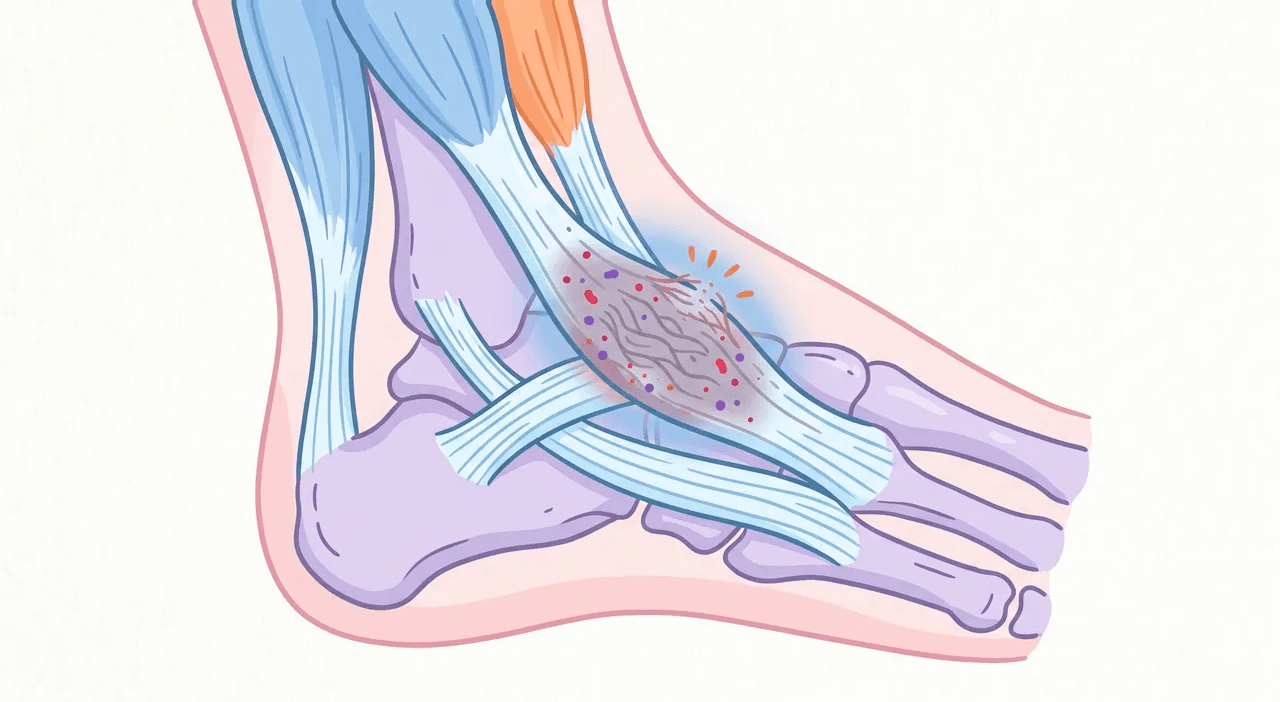
- Poor Energy Absorption: Stiffer tendons are crucial for efficiently and safely transmitting force from the muscles to the bone (Kubo et al., 2001). Tendons that are too flexible cannot properly absorb ground-reaction forces generated explosively and with high force during dynamic actions. The tendon instead takes most of the load, stretching excessively—a prime cause of microtears and eventually tendinopathy (Mersmann et al., 2017).
- Damage at a Micro-level: Intensity and metabolic conditioning lead to tiredness, which undermines smooth body motion. When movement becomes less accurate, the tendon is loaded erratically through many cycles. Ex vivo studies reveal that repeated cyclical overload reduces tendon stiffness over time and increases heat dispersion, reflecting accumulating microscopic damage and eventual structural failure (Lorimer & Hume, 2016).
- Braking Risks When Surfaces Are Soft: Soft landing surfaces or high braking forces are common in many boot-camp exercises. A high percentage of Achilles and patellar tendon injuries arise from vigorous braking coupled with untrained or irregular lower-trunk resistance (Lorimer & Hume, 2016).
Adding Stability: The Significance of Static Strength Training
If one has strong muscles capable of great power, but the tendons lack the stiffness necessary to translate and withstand it, the weak point shifts to the tendon. It will stretch far beyond what is healthy, paving the way for gradual decay.
To shield the body from the powerful impacts of high-intensity training, athletes need to deliberately enhance tendon stiffness. This cannot be effectively achieved with light, high-repetition exercises. Lower-intensity workouts, such as regular walking or resistance below 40% of 1RM, do not meet the mechanical requirements to enhance tendon properties sufficiently (Grosset et al., 2014). Instead, the answer involves high-load Isometric Strength Training (IST).
1. Enhancing Tendon Stiffness Along with Structural Adaptation
To help form the collagen cross-links that construct a rigid, powerful tendon, tissue demands high mechanical strain (Mersmann et al., 2017). A prolonged heavy isometric hold—such as a stationary squat against an immovable barbell or a single-leg calf raise using a heavy weight—provides the exact stimulation required by the fibers.
Isometric training executed at a high voluntary capacity, usually 80–100% of maximum voluntary contraction, and maintained long enough increases both tendon stiffness and Young’s modulus, a measurement of a substance’s elastic resistance (Kubo et al., 2001). Stiffer tendons make torque production quicker and help prevent muscles from tearing when stretched excessively during sudden activity (Kubo et al., 2001).
2. The Healing Impact
For those suffering tendon pain brought on by extensive boot-camp training, isometrics can be therapeutically beneficial. Research published in the British Journal of Sports Medicine found that powerful isometric contractions immediately reduced cortical inhibition and offered substantial relief from patellar tendinopathy pain (Rio et al., 2015). This analgesic effect can last nearly 50 minutes after the exercise, making training easier without hiding compensations that may cause injury (Rio et al., 2015; Smith, 2023).
3. Greater Performance and Muscle Safety
Position and muscle length are critical when applying isometric exercises. Holding isometrics in long-muscle positions, such as a low squat rather than a high squat, can trigger favorable bodily and tissue adaptations. This produces stronger muscles and more resilient tendons while enabling joints to adapt across ranges of movement, especially at the extremes where tissues can be stretched or torn under pressure. High-resistance isometrics can develop resilience and strength simultaneously.
Things Student Athletes Can Do
If you are training hard, constantly at risk, or potentially performing exercises incorrectly, your priorities need to change. Muscle and connective tissues need recovery.
- Add isometrics into the training program: Before advancing to speed training and heavy lifts, incorporate specific blocks of four to five repetitions, each lasting 4–30 seconds at high muscular effort, to give tendons enough strain to adapt (Mersmann et al., 2017).
- Give tendons time to recover: Tendons cannot restore as quickly as muscles. Avoid high-intensity functional training for body parts worked earlier the same day unless ample attention has been given to recovery.
- Warm up using isometrics: If tendon pain is present before a session, consider a strong 30-second static hold such as a Spanish squat or wall sit. It may relieve pressure, reduce inhibitory signals, and prepare the tissue for exercise (Rio et al., 2015).
- Begin an isometric strength regimen: 30-minute 30inThirty sessions implement full-body exercises for tendon-stiffness improvement and recovery. Intensity is based on the athlete’s current need.
High-intensity workouts are effective for building cardiovascular health, but without strong, robust tendons they are like building on fragile earth. Combining them with tough, high-load isometric holds bridges the gap so the body can withstand greater pressure through increased connective-tissue stiffness.
References
- Grosset, J. F., Breen, L., Stewart, C. E., Burgess, K. E., & Onambele, G. L. (2014). Influence of exercise intensity on training-induced tendon mechanical properties changes in older individuals. AGE, 36(3). https://doi.org/10.1007/s11357-014-9657-9
- Kubo, K., Kanehisa, H., Ito, M., & Fukunaga, T. (2001). Effects of isometric training on the elasticity of human tendon structures in vivo. Journal of Applied Physiology, 91(1), 26–32. https://doi.org/10.1152/jappl.2001.91.1.26
- Lorimer, A. V., & Hume, P. A. (2016). Stiffness as a risk factor for Achilles tendon injury in running athletes. Sports Medicine, 46(12), 1921–1938. https://doi.org/10.1007/s40279-016-0526-9
- Mersmann, F., Bohm, S., & Arampatzis, A. (2017). Imbalances in the development of muscle and tendon as risk factor for tendinopathies in youth athletes: A review of current evidence and concepts of prevention. Frontiers in Physiology, 8. https://doi.org/10.3389/fphys.2017.00987
- Rio, E., Kidgell, D., Purdam, C., Gaida, J., Moseley, G. L., Pearce, A. J., & Cook, J. (2015). Isometric exercise induces analgesia and reduces inhibition in patellar tendinopathy. British Journal of Sports Medicine, 49(19), 1277–1283. https://doi.org/10.1136/bjsports-2014-094386
- Smith, S. (2023). Difference between Isometric and Isotonic Exercises and Their Effects on Patients with Patellar Tendinopathy: A Critically Reviewed Study. OpenRiver.
Biography
Gary Augustine Warren, BS, CSCS, LMT
Since earning a Bachelor's degree in Health and Sports Sciences from the University of Oklahoma in 1997, Gary has built an illustrious near 30-year career as a Certified Strength and Conditioning Specialist (CSCS) and personal trainer through the National Strength and Conditioning Association (NSCA). As an Oklahoma-licensed massage therapist (LMT), he has honed a holistic approach to fitness and recovery. He has served as a staff member or performed contract work at prestigious institutions like UCLA, Long Beach State, and the University of Oklahoma. Gary's expertise extends beyond academia, with impactful roles in two sports entertainment organizations and the private sector. His innovative training methods and dedication to client success have consistently elevated athletic performance and well-being over decades of professional practice.